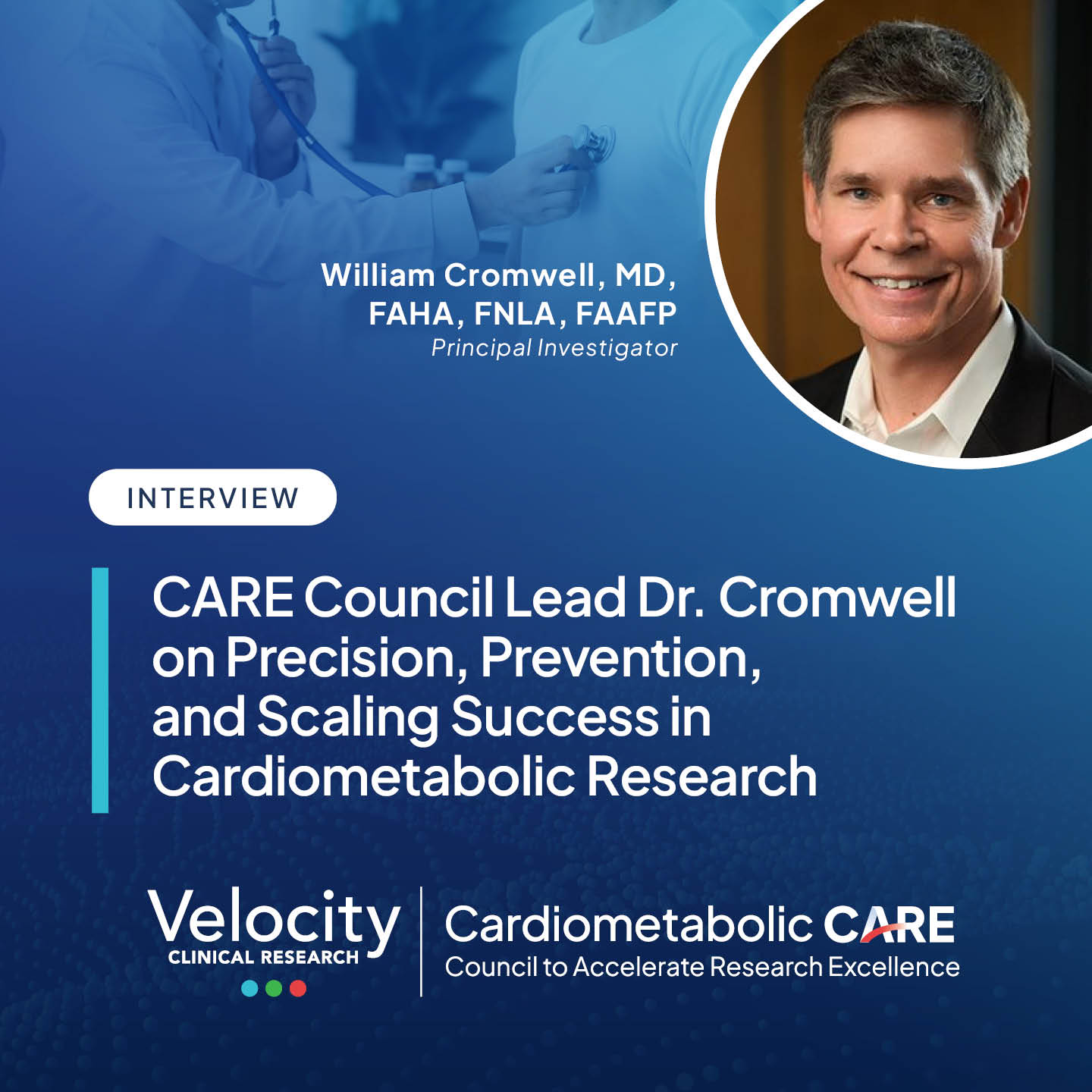
There is a logic to the way William Cromwell, MD speaks about cardiometabolic risk — if this, then that. But you never feel as though it would come at the expense of the person sitting opposite him.
Over the past 35 years of specialty practice, research, teaching, and publishing, his emphasis has remained the same. How do we accurately identify an individual’s heart attack and stroke risk, and how can we individualize therapies that address the root cause of their condition?
When asked how he engages with his patients, he’s deliberate.
“Everyone has a vision of what a good day looks like for them 10 years from now,” he says. “For those with high cardiometabolic risk, we discuss where they are now, how heart attacks or stroke impact that day 10 years from now, and what options are available to improve their likelihood of getting to that future point, in good health.”
It’s tricky for a 40-year-old who wasn’t expecting bad news to hear they have cardiovascular disease, but Dr. Cromwell’s career has been dedicated to ensuring the people he sees in the clinic have choices.
“When I first began my career, we had limited tools to assess individual risk and very few treatments proven to improve heart attack or stroke events,” he recalls. “Most cholesterol-lowering medications were minimally effective and difficult to tolerate. Bile acid sequestrants were like drinking sand, and niacin produced tremendous flushing.”
Now, the field looks entirely different. Outcome-proven therapies, such as statins, ezetimibe, bempedoic acid, and PCSK9 inhibitors, are established. Newer therapies target risk with far greater precision. Treatments in development are even more specific, aimed at particular proteins and pathways rather than broadly affecting the whole system. The shift, he says, has been extraordinary.
From Chemistry to Cholesterol
But Dr. Cromwell did not start out with medicine in mind. A fascination with space and the mechanics of discovery led him to train as a chemist, though he never made it to NASA. “If you can’t be a rocket scientist,” he jokes, “marry one.” His wife is an aerospace engineer, and after 43 years together, he is still obviously very proud of her.
His instinct for systems thinking carried naturally into medicine, though. Vascular disease, the leading cause of death in the United States, struck him as a problem that ought to be solved. If you could understand the contributing factors — and measure them properly — you could intervene earlier with greater precision.
And so began a career that has spanned clinical care, analytic test development, and clinical research. Dr. Cromwell’s group has co-authored or provided analytic data for more than 700 peer-reviewed publications, including analyses of samples from hundreds of cardiovascular trials. And yet, for all the data, his focus remains personal.
The People Behind the Numbers
Dr. Cromwell is realistic about what people bring into the room. For him, the consultation is less about issuing instructions and more about building understanding.
“Part of it is giving people an opportunity to tell me where they are and how they got here,” he says. “What’s worked, what hasn’t worked, what’s frustrating, what concerns do they have about diet, exercise, or medications?”
Talking to him, he’s very obviously data-oriented, practiced at assessing the most likely cause of each condition, and what therapies are most likely to reduce a person’s risk. So when things don’t go as they should – or could – that rankles.
In a career featuring tens of thousands of patients, there is one in particular who stays with him. Sue had an inherited cholesterol disorder and was at high risk from a young age. She was no longer under his care when she later died unexpectedly following a heart attack.
It’s an episode that shaped him, and, as much as he clearly mourns the human cost, the idea that it was avoidable obviously irritates him. He knew, on hearing the news, that her death didn’t have to happen, and the desire to ensure reduced cardiovascular risk in future patients was a turning point for him. He decided then to spend the rest of his professional life doing what he could to ensure fewer people found themselves in that position, and fewer families were blindsided by something preventable.
Scaling Success
At Velocity, Dr. Cromwell now serves as Medical Director of the Durham site and leads the Cardiometabolic CARE Council. At his home site in Durham, he has helped establish a cardiometabolic research program with strong recruitment across diverse populations. But his role extends beyond one location.
Through the CARE Council, he works across Velocity’s network — advising on protocol design, feasibility, data interpretation, and helping ensure that operational standards and research outcomes remain consistent across sites.
He sees Velocity’s network model as a genuine advantage for sponsors, not because it is a collection of sites, but because it is a system for scaling what works. “It’s not just reproducing sites,” he says. “It’s scaling success.” In practice, that means shared best practices, similar SOPs, and a consistent approach to patient care and engagement, while still allowing individual sites to retain what makes them effective in their local markets.”
In his roles, he works both externally and internally — advising on protocol development, feasibility, and data interpretation, while also training and supporting site staff. It is less about hierarchy and more about translation: understanding what sponsors are trying to solve and ensuring Velocity is positioned to deliver.
A Future 10 Years from Now
As for where cardiometabolic research is heading, he sees a field becoming increasingly precise. Technologies such as gene silencing and RNA-based therapies are allowing researchers to target individual proteins with unprecedented specificity. Long-standing challenges, such as lipoprotein(a), are finally seeing credible therapeutic options move through late-stage development.
For someone who began in an era of limited tools and blunt interventions, it feels like a significant shift. But his motivation has not changed. “How do you do the right thing, one patient at a time?” he says.
It is a question that runs quietly beneath everything — the analytics, the protocols, the advisory boards, the network strategy. In Dr. Cromwell’s world, science matters enormously. But not as much as the person sitting in front of him, imagining what ten good years from now might look like… and how they’ll get there.