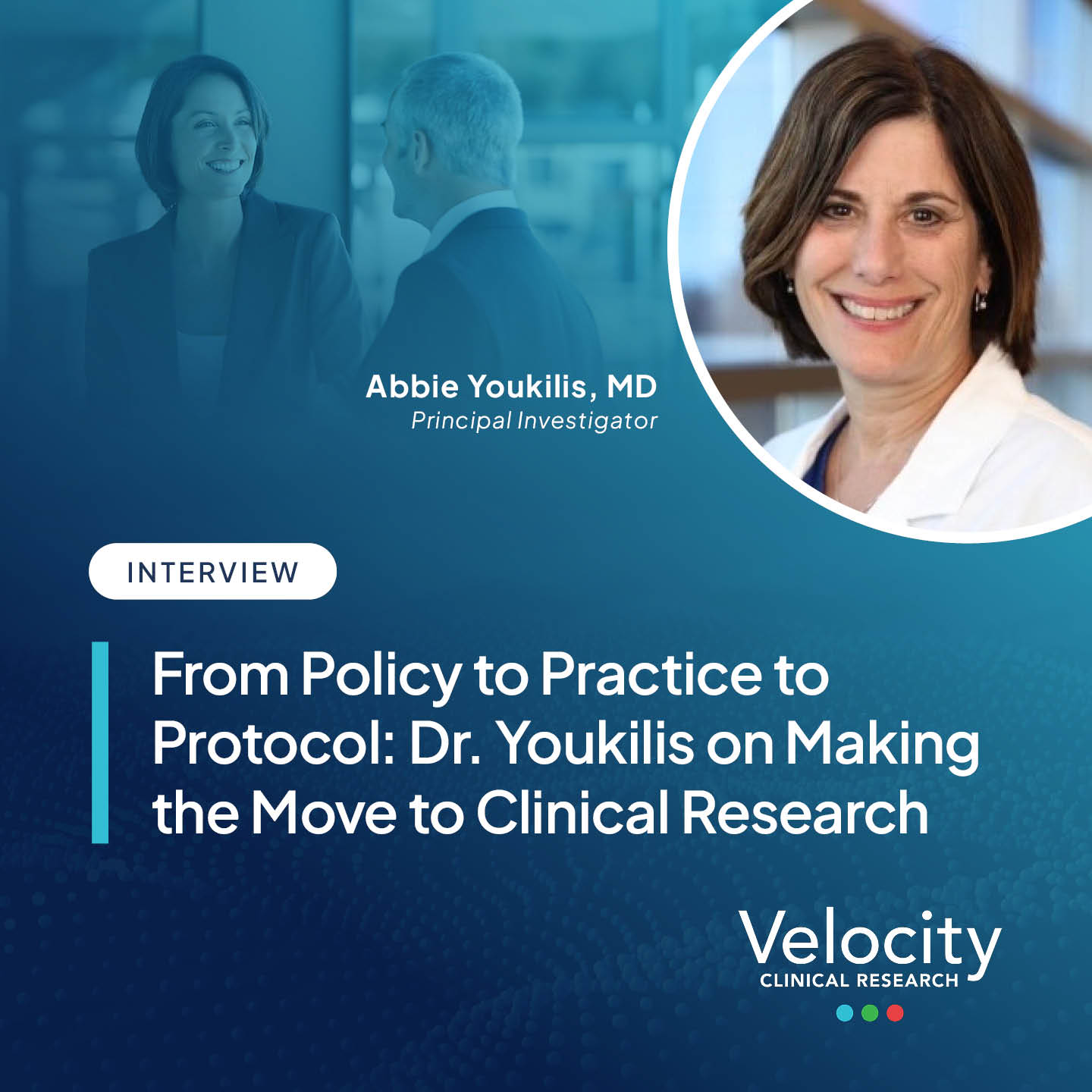
For much of her early career, Abbie Youkilis, MD focused on changing healthcare from the outside in. Having begun as a pre-med student at Duke, she pivoted into public policy, earning a master’s degree from Harvard and working in Washington on health policy and aging issues. But over time, she found herself drawn back to something more impactful — individual patients and the opportunity to make a meaningful difference one patient at a time.
She completed her pre-medical studies while continuing to work full-time in Washington and New York, studying in the evenings before taking the MCAT and entering medical school at 30. Residency followed, along with the joyful demands of building a family and managing three small children. It was, she says plainly, a busy period, “It’s good that I don’t need much sleep!”
Policy to Practice
What followed was a career specializing in Internal Medicine, practicing inpatient and primary care in different hospital systems in Cincinnati. Dr. Youkilis talks warmly of that time and her patients, “I do miss caring for my patients and I treasure the relationships I had with them,” she remembers.
As much as Dr. Youkilis valued her time in primary care, she’s open about her struggle with the ‘always-on’ nature of the work. “It’s hard to switch off,” she explains, “There came a time during Covid when patients had increased access to physicians via MyChart, but there weren’t yet the processes in place to support doctors. It really was 24/7.”
Stepping into Clinical Research
Searching for alternatives to primary care, Dr. Youkilis reached out to two former colleagues — Matthew Wenker, MD and Douglas Logan, MD. Both were effusive about the opportunities in clinical research, and the scale of the impact she could have in that field appealed to her.
At the start of her career, Dr. Youkilis had entered public policy with the hope of influencing healthcare at a systems level. In primary care, she had found satisfaction in helping individuals every day. Clinical research offered a way to bridge the two, combining the patient-focused work she loved with the opportunity to have a broader impact. “Knowing that we’re working here on things that are going to bring further improvements to the vast majority of folks with chronic disease … even though I’m just a small part of it, I feel good about doing that.”
Joining clinical research as part of an integrated network like Velocity meant she wasn’t thrown in at the deep end. She joined Dr. Logan’s team as a sub-I, “You can’t ask for a better person to mentor you,” Dr. Youkilis says of Dr. Logan. “He’s done this work for a long time; he’s incredibly intelligent and is always prepared. When CRAs came to the site, he always had really good questions, and he frequently identified additional issues for them to consider.”
Dr. Logan retired at the end of 2025, and Dr. Youkilis took over as PI on his studies. She has found the transition from sub-investigator to principal investigator smooth, thanks to the support of the outstanding Cincinnati Springdale CRC team and her other Velocity mentor, Dr. Charles Eger. “Velocity does an excellent job of hiring highly qualified and motivated people and training them well. That makes a real difference.”
As a sub-I, she appreciated the opportunity to contribute to the team. As a PI, she is ultimately responsible for documentation, oversight, compliance, and the integrity of the data generated. “It’s about making sure all the pieces are in place,” she says. “You want to be confident that everything has been done properly and on time.”
The Connection Between Primary Care and Trial Delivery
Working on hyperlipidemia, diabetes and obesity studies, and vaccine studies, she sees firsthand how incremental advances translate into real clinical impact. Many of these are conditions she managed daily in primary care, and she understands the limits of existing therapies.
“You try hard as you can to get a diabetic under good control, or somebody with heart disease not to have another cardiovascular event,” she reflects, “And the therapies are good, but they don’t work sufficiently for everyone.”
It’s clear the human impact of her work is never far from her mind, and she considers every molecule she works on in the context of what it might eventually deliver to patients like those she saw practicing primary care.
Different Pace, Same Purpose
The Cincinnati Springdale site runs a number of trials, both healthy volunteer studies and those for patients in active disease states. She’s quick to note that both provide participants with health care they might otherwise struggle to access. Vaccine trials can help secure possible coverage for those who don’t meet insurers’ vaccination criteria, while screening visits can flag symptoms that need further investigation, such as elevated blood pressure or abnormal lab results.
For physicians considering a move into research, her advice is characteristically practical. Speak to people already doing the job and, if you can, shadow them for a few days. “The pace is different,” She explains, “When you’re in primary care, you’re basically just on the run the entire day — in one room, the next room — seeing patients non-stop. Here, there’s often time in between seeing patients, and during that time period there’s an opportunity to dig into the science and complete regulatory compliance documentation.”
For Dr. Youkilis, that change of pace has been restorative. It has allowed her to tap into decades of experience as a clinician and contribute to the bigger picture in a way she thought she might not again when she left Washington.
It has also required a different kind of discipline. In research, preparation matters. Protocols must be thoroughly understood, and questions must be anticipated before they are asked. It is work that rewards precision and thoughtfulness — two qualities that Dr. Youkilis demonstrates throughout our conversation.
This move is, in many ways, a natural convergence of everything that came before — her career in health policy to help improve outcomes for everyone, and her decades in clinical care, treating one patient at a time. In research, she has found a way to honor both.